The Dark Side of Deep Frying: Why Oil Turns Black and What It Means for Your Health

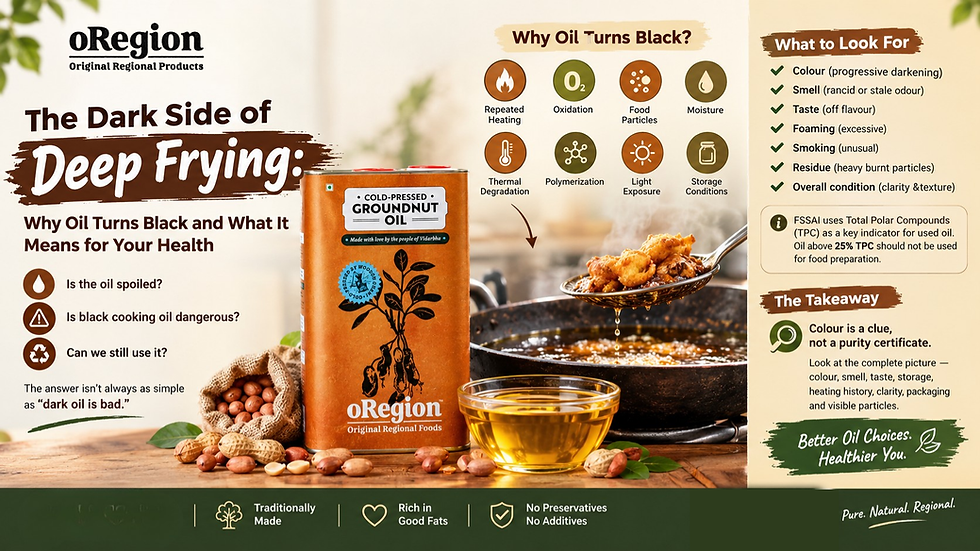
When cooking oil starts turning dark during deep frying, many of us immediately wonder:
Is the oil spoiled?
Is black cooking oil dangerous?
Can we still use it?
The answer is not always as simple as “dark oil is bad.”
A Groundnut Oil Colour Change can happen for several reasons. Natural pigments, heat, oxygen, moisture, food particles, repeated frying, light exposure, storage conditions, oxidation, and thermal degradation can all change the appearance of oil.
However, there is an important distinction between fresh Cold Pressed Groundnut Oil that naturally has a deeper colour and oil that has progressively darkened after repeated high-temperature frying.
Repeated frying changes the physical, chemical, nutritional, and sensory properties of edible oil. In India, the Food Safety and Standards Authority of India (FSSAI) uses Total Polar Compounds (TPC) as an important quality indicator for used frying oil and has set a 25% limit beyond which vegetable oil should not be used.
So, instead of judging cooking oil by colour alone, we should look at the complete picture: colour, smell, taste, storage, heating history, food residue, and overall condition.
Why Does Cooking Oil Turn Black When Deep Frying?
Cooking oil can become darker during deep frying because of repeated heating, oxidation, food particles, moisture, thermal degradation, and polymerization.
As oil is repeatedly exposed to high temperatures, oxygen and moisture, its chemical structure gradually changes. Food particles left behind from frying can also become increasingly dark and burn, contributing to the colour of the oil.
A darker colour does not automatically mean that every drop of oil has become unsafe. However, progressive darkening combined with other warning signs can indicate that the oil has deteriorated.
What Happens to Oil During High-Temperature Frying?
Deep frying exposes oil to several conditions simultaneously:
High heat
Oxygen from the surrounding air
Water released from food
Food particles and crumbs
Repeated heating and cooling
Oxidation
Hydrolysis
Thermal degradation
Polymerization
These reactions do not happen independently. They interact as frying continues.
For example, moisture from food can contribute to hydrolytic reactions, while oxygen and heat promote oxidation. Food residues can continue cooking in the oil and eventually become dark or burnt.
This is why oil that has been used repeatedly may look, smell, and behave differently from fresh oil.
Why Does Reused Frying Oil Become Darker?
Reused frying oil can become progressively darker because food residues accumulate and high-temperature exposure continues to promote chemical reactions.
You may also notice changes in:
Aroma
Taste
Viscosity
Foaming
Smoking behaviour
Clarity
Overall freshness
FSSAI notes that repeated frying forms Total Polar Compounds and changes the physicochemical and sensory properties of edible oil.
Is Black or Burnt Cooking Oil Bad for Your Health?
Severely degraded, repeatedly heated oil should not be treated like Fresh Cooking Oil.
We should also avoid saying that every dark oil is automatically toxic. Colour is only one observation and cannot measure oxidation or TPC by itself.
If frying oil has become very dark, develops an unpleasant or rancid smell, produces excessive foam, smokes unusually early, contains substantial burnt residue, or has been repeatedly heated, replacing it is a more sensible choice.
Why Does Groundnut Oil Change Colour?
A Groundnut Oil Colour Change can occur because of natural pigments, processing, temperature, oxidation, light, moisture, storage, and repeated heating.
This is particularly relevant when comparing traditionally extracted Cold Pressed Groundnut Oil with highly refined Peanut Oil.
Cold pressed oils generally undergo less intensive processing, so their colour and clarity can naturally vary from batch to batch.
What Is the Normal Colour of Pure Cold Pressed Groundnut Oil?
There is no single universal colour that proves an oil is pure.
Fresh Cold Pressed Groundnut Oil may appear pale yellow, golden, or amber depending on factors such as:
Peanut variety
Growing conditions
Extraction process
Filtration
Naturally occurring pigments
Storage conditions
Therefore, a slightly deeper golden colour does not automatically indicate adulteration or poor quality.
Does Darker Groundnut Oil Mean It Is Adulterated?
No. Colour alone cannot prove Groundnut Oil adulteration.
Different edible oils can have similar colours, while genuine oil can naturally vary in appearance.
If we need to determine whether Cold Pressed Peanut Oil has been mixed with another oil, appropriate laboratory testing is more dependable than comparing the colour of two bottles.
Why Can Cold Pressed Groundnut Oil Look Cloudy?
Cloudiness can be completely different from the darkening associated with repeated frying.
Because minimally processed Cold Pressed Oils may retain naturally occurring minor components, they can sometimes have more variation in clarity than extensively refined oils.
Is Cloudiness in Groundnut Oil a Sign of Purity?
Not by itself.
Cloudiness can be associated with:
Temperature changes
Naturally suspended components
Sedimentation
Waxes or crystallization
Moisture
Processing characteristics
Therefore, we should not use “cloudy = pure” or “clear = impure” as universal rules.
Why Is There Sediment at the Bottom of My Groundnut Oil Bottle?
Fine sediment can occur in minimally processed Cold Pressed Peanut Oil because naturally occurring particles may remain suspended and later settle due to gravity.
A bottle may therefore appear clearer near the top while showing some sediment at the bottom.
That appearance should be interpreted together with the product's processing method and storage conditions.
Is Sediment in Cold Pressed Oil Dangerous?
Not necessarily.
Natural sediment is not automatically a safety problem. However, we should distinguish expected fine sediment from unexpected foreign material.
Mould-like growth, unusual particles, water separation, damaged packaging, or an abnormal smell deserve greater attention and should not simply be labelled “natural.”
Why Does Groundnut Oil Turn Dark Brown When Heated?
Groundnut oil can turn darker during prolonged or repeated heating because of oxidation, thermal degradation, food residues, moisture, and polymerization.
The change is usually more meaningful when it happens progressively after repeated frying rather than when comparing naturally different batches of fresh oil.
How Does Heat Accelerate Groundnut Oil Oxidation?
Oxidation occurs when oxygen reacts with susceptible components of oil.
Heat can accelerate these reactions. Initially, oxidation produces compounds called hydroperoxides. These primary oxidation products can later break down into secondary compounds, including aldehydes and ketones.
This chemical process can eventually influence the oil's:
Aroma
Flavour
Freshness
Stability
Appearance
What Is Lipid Oxidation in Peanut Oil?
Lipid oxidation is a chain of chemical reactions involving oxygen and susceptible fatty acids.
It can be accelerated by:
High temperatures
Oxygen exposure
Light
Long storage
Repeated frying
Poor storage conditions
This is one reason why protecting Cold Pressed Oil from heat, light, and unnecessary air exposure matters.
What Are Hydroperoxides in Oxidized Groundnut Oil?
Hydroperoxides are important primary products of lipid oxidation.
However, we cannot reliably determine their presence or concentration simply by looking at an oil bottle.
Laboratory measurements, such as peroxide value, provide much more meaningful information about oxidation than visual inspection alone.
What Happens When You Reuse Groundnut Oil for Deep Frying?
Repeated frying can gradually change the chemical and sensory characteristics of Groundnut Oil.
Every additional heating cycle creates another opportunity for oxidation, hydrolysis, polymerization, and interaction with food residues.
FSSAI specifically identifies repeated frying as a cause of Total Polar Compound formation and states that used oil above the prescribed TPC limit should not be used for food preparation.
How Many Times Can You Reuse Deep Frying Oil?
There is no universal number that guarantees safety for every oil and every frying situation.
The condition of frying oil depends on:
Oil type
Frying temperature
Frying duration
Food being fried
Amount of moisture
Food particles
Storage between uses
Number of heating cycles
Overall oil deterioration
Rather than relying only on a fixed number of uses, we should pay attention to deterioration and follow applicable food-safety guidance.
What Are the Signs That Frying Oil Has Broken Down?
Warning signs can include:
Progressive darkening
Rancid or stale odour
Unpleasant flavour
Excessive foaming
Unusual smoking
Sticky or unusually thick texture
Heavy food residue
Significant change in frying performance
FSSAI also identifies dark and murky oil, tough foam, and unusual smoke as practical signs associated with deteriorated used cooking oil.
Can Light and Storage Change Groundnut Oil Colour?
Yes. Light, oxygen, temperature, and storage conditions can all influence oil stability.
For Cold Pressed Oils, sensible storage is particularly important because preserving quality is not only about the oil itself; packaging and handling also matter.
Does Sunlight Make Cold Pressed Oil Deteriorate Faster?
Prolonged exposure to light can promote photo-oxidation, which can contribute to changes in flavour, aroma, stability, and appearance.
For this reason, we should avoid leaving bottles of Cold Pressed Groundnut Oil in direct sunlight for extended periods.
How Should Cold Pressed Groundnut Oil Be Stored?
We recommend keeping it:
Tightly sealed
Away from direct sunlight
Away from excessive heat
In a cool, dry place
Away from moisture
In suitable packaging
Protected from unnecessary oxygen exposure
Good storage cannot stop deterioration forever, but it can help slow unwanted changes.
Can Moisture Cause Groundnut Oil to Become Cloudy or Change Colour?
Moisture can enter cooking oil through wet utensils, condensation, ingredients, or unsuitable storage.
During frying, food naturally releases water into the hot oil. This interaction can contribute to chemical changes and splattering.
Does Moisture Always Make Groundnut Oil Cloudy?
No.
Cloudiness has several possible explanations.
Temperature changes, natural suspended components, crystallization, waxes, and moisture can all affect the visual appearance of oil.
That is why we should not diagnose the cause of a cloudy bottle simply by looking at it.
Groundnut Oil Oxidation vs Contamination vs Adulteration
These three issues are often confused, but they are not the same.
How Can You Recognize Oxidized Groundnut Oil?
We should consider the complete pattern rather than colour alone.
Oxidation becomes more concerning when progressive darkening occurs together with:
Rancid odour
Stale flavour
Reduced freshness
Long storage
Repeated heating
Significant exposure to heat, oxygen, or light
What Can Cause Groundnut Oil Contamination?
Contamination may result from:
Poor handling
Damaged packaging
Moisture entry
Foreign material
Unsuitable storage
Poor hygiene
Colour alone cannot reliably identify contamination.
Does Adulterated Groundnut Oil Always Look Different?
No.
Adulteration may produce little or no obvious visual difference.
That is why a product cannot be certified as pure simply because it looks golden, clear, cloudy, or dark.
Can You Test Groundnut Oil Purity at Home?
Searches for a Groundnut Oil Purity Test often lead to viral methods involving freezing, burning, mixing, or observing colour changes.
These methods can sometimes demonstrate physical properties, but they should not be presented as definitive proof of purity or adulteration.
Are Viral Colour, Freezing, Burning, or Mixing Tests Reliable?
Not as universal purity tests.
A physical change may have several explanations, and a visual observation does not necessarily identify which oil is present or whether adulteration has occurred.
For reliable identification, validated analytical testing is preferable.
How Is Groundnut Oil Purity Tested in a Laboratory?
Depending on the testing objective, laboratories may assess parameters such as:
Free fatty acid content
Peroxide value
Fatty acid composition
Moisture and volatile matter
Oxidation-related indicators
Other applicable regulatory parameters
These measurements provide considerably more information than a simple visual colour comparison.
When Should You Consider Laboratory Testing?
Professional testing may be appropriate when:
Adulteration is suspected
Contamination is suspected
A commercial quality dispute exists
A chemical test gives an unexplained result
The oil develops unusual physical characteristics
Sensory changes cannot be explained by storage or processing
What Does a Colour Change in a Groundnut Oil Chemical Test Mean?
A colour reaction in a laboratory or chemical procedure should not be confused with normal Groundnut Oil Colour Change.
Why Can Groundnut Oil Change Colour After Adding a Chemical Reagent?
The result can depend on:
Reagent used
Concentration
Temperature
Reaction time
Sample preparation
Testing procedure
Therefore, the meaning of a colour change depends entirely on the validated method being used.
Can One Colour Reaction Confirm Groundnut Oil Purity?
No.
A single visual colour reaction should not automatically be treated as a universal purity certificate.
The analytical method must be appropriate for the specific quality characteristic or adulterant being investigated.
Is the Maillard Reaction Responsible for Dark Cooking Oil?
Not usually.
The Maillard reaction primarily occurs between reducing sugars and amino compounds in food during high-temperature cooking.
It is strongly associated with browning in foods and can contribute to acrylamide formation in certain starchy foods.
EFSA explains that acrylamide can form in foods during high-temperature cooking, including frying, particularly when temperatures exceed about 120°C and moisture is low.
The FDA similarly explains that acrylamide forms mainly in certain plant-based foods when sugars react with the amino acid asparagine during high-temperature cooking.
Therefore, acrylamide formation should not be confused with the reason frying oil itself turns black.
The darkening of repeatedly used cooking oil is more closely associated with oxidation, thermal degradation, food residues, and polymerization.
How Long Does Groundnut Oil Take to Become Rancid?
There is no universal number of days after which every bottle of Groundnut Oil becomes rancid.
Shelf life depends on:
Packaging
Oxygen exposure
Temperature
Light
Processing method
Antioxidant content
Whether the container is opened
Frequency of use
Repeated heating
Does Cold Pressed Groundnut Oil Have a Fixed Shelf Life?
Every packaged product has its own recommended storage and best-before information.
Instead of deciding that an oil is good or bad based on colour alone, we should follow the manufacturer's storage instructions and best-before date while also paying attention to noticeable changes in smell, taste, packaging, and condition.
Cold Pressed Groundnut Oil vs Refined Peanut Oil: Does Colour Tell the Difference?
Colour does not provide a reliable way to determine whether an oil is cold pressed or refined.
The major distinction is the processing method.
Minimally processed Cold Pressed Groundnut Oil can retain more of its naturally occurring components, which can contribute to variation in colour and clarity.
Refined oils generally undergo more extensive processing and may have a more uniform visual appearance.
Why Can Cold Pressed Oil Have More Natural Colour Variation?
Natural variation can result from:
Seed variety
Agricultural conditions
Extraction
Filtration
Natural pigments
Storage
This variation is not automatically a quality defect.
Is Clear Oil Automatically Better Than Cloudy Oil?
No.
Clarity is a visual characteristic, not a complete measure of purity, safety, freshness, or nutritional quality.
We should evaluate oil using the complete product-quality picture.
How to Choose Good Cold Pressed Groundnut Oil
When purchasing Cold Pressed Groundnut Oil, we should look beyond colour.
What Should You Check Before Buying Cold Pressed Groundnut Oil?
Consider checking:
Ingredient information
Processing method
Manufacturer details
Packaging quality
Best-before date
Storage instructions
Product transparency
Available quality or testing information
A trustworthy product should communicate what it is, how it is processed, how it should be stored, and how consumers should use it.
Should You Choose Oil Based Only on Colour?
No.
A golden colour does not automatically prove purity, and a cloudy appearance does not automatically prove adulteration.
The same principle applies across Cold Pressed Oils, including Cold Pressed Mustard Oil, Cold Pressed Sesame Oil, Cold Pressed Sunflower Oil, Cold Pressed Coconut Oil, and Cold Pressed Flaxseed Oil.
How oRegion Approaches Cold Pressed Oil Quality
At oRegion, we believe consumers should understand the natural characteristics of traditionally extracted oil rather than judging quality by visual perfection alone.
Our approach to Cold Pressed Oil focuses on the natural character of minimally processed oil while recognizing the importance of responsible sourcing, hygienic processing, suitable packaging, storage, and quality control.
Why oRegion Focuses on the Natural Character of Cold Pressed Oil
Cold pressed extraction can preserve the natural character of the oil, which means colour and clarity may vary naturally.
We do not believe consumers should be taught that an artificially clear appearance is the definition of quality.
How Should Natural Colour and Clarity Be Understood?
A naturally coloured or slightly cloudy Cold Pressed Groundnut Oil should be evaluated in context.
The important questions are:
How was it processed?
How was it stored?
Does it smell normal?
Has it been repeatedly heated?
Is the packaging intact?
Does the product provide appropriate quality information?
That is a much stronger approach than using colour as a standalone purity certificate.
Groundnut Oil Colour Change
If Groundnut Oil Is Slightly Cloudy
Temperature changes or naturally occurring suspended components may explain the appearance.
If Sediment Has Settled at the Bottom
Natural sedimentation can occur in minimally processed Cold Pressed Oil.
If Groundnut Oil Becomes Dark After Repeated Frying
Heat, oxygen, moisture, food particles, oxidation, thermal degradation, and polymerization may contribute.
If Groundnut Oil Develops a Rancid Smell
Oxidative deterioration becomes more likely, particularly after prolonged storage or repeated heating.
If the Oil Suddenly Develops an Unusual Appearance
Check the packaging, storage conditions, smell, heating history, and product information. If contamination or adulteration is suspected, professional testing is preferable to an internet-based visual test.
Frequently Asked Questions
Why does groundnut oil change colour when heated?
Heating can accelerate oxidation and thermal degradation. Repeated frying can also introduce moisture and food particles, causing the oil to progressively change in colour, aroma, and flavour.
Why is my groundnut oil turning dark brown?
Possible causes include repeated heating, oxidation, food residues, thermal degradation, natural pigments, and prolonged storage. Colour alone cannot establish whether the oil is spoiled.
Why does Peanut Oil get cloudy or dark?
Temperature changes, natural suspended components, sedimentation, light, oxidation, food residues, and repeated heating can all affect Peanut Oil's appearance.
Is Groundnut Oil safe after changing colour?
Colour change alone cannot determine safety. Consider the oil's smell, taste, storage conditions, heating history, packaging, and visible particles. Severely degraded or repeatedly heated oil should be avoided.
Does adulterated Groundnut Oil always change colour?
No. Adulteration may not produce an obvious visual difference. Laboratory analysis is more reliable than colour comparison.
What is the normal colour of pure Groundnut Oil?
Pure Groundnut Oil does not have one universal colour. Depending on variety, extraction, filtration, and storage, Cold Pressed Groundnut Oil can range from pale yellow to golden or amber.
Is cloudy Cold Pressed Groundnut Oil normal?
It can be. Temperature, natural suspended components, waxes, crystallization, sediment, and moisture can influence clarity. Cloudiness alone is neither proof of purity nor proof of spoilage.
Can you identify rancid oil by smell?
A rancid or stale smell can be an important warning sign of deterioration, but smell alone cannot measure all chemical changes in oil.
How can I know if frying oil should be discarded?
Progressive darkening, unpleasant odour, excessive foaming, unusual smoking, heavy residue, sticky texture, and repeated high-temperature use are warning signs. For commercial operations, TPC testing provides a more objective quality assessment. FSSAI specifies that used oil above 25% TPC should not be used.
Can a home colour test prove oil purity?
No. Freezing, burning, mixing, or colour-based viral tests should not be treated as definitive tests for adulteration or purity.
Final Takeaway: Groundnut Oil Colour Is a Clue, Not a Purity Certificate
A Groundnut Oil Colour Change can have many explanations.
Natural pigments, processing, temperature, oxidation, light, moisture, storage, repeated frying, food residues, contamination, and adulteration can all influence how oil looks.
The key distinction is this: not every colour change means spoilage, and not every golden, clear, or cloudy appearance proves purity.
When we notice a change in Cold Pressed Groundnut Oil, we should look at the entire picture—colour, smell, taste, storage conditions, heating history, clarity, packaging, and visible particles.
Repeatedly heated oil deserves particular caution because chemical and physical changes accumulate with frying. FSSAI's used-cooking-oil framework recognizes Total Polar Compounds as an important quality indicator and sets 25% as the limit beyond which vegetable oil should not be used.
At oRegion, we believe Cold Pressed Oil does not need artificial visual perfection to be understood or appreciated. Natural variation can be part of traditionally extracted oil, while good quality still depends on responsible sourcing, hygienic processing, appropriate packaging, proper storage, and meaningful quality controls.
In simple terms: colour can tell us that something has changed—but it cannot tell us exactly why.
Follow us for more wellness tips
👉 Buy Now on oregion.in
📸 Instagram: @oRegion.in
📘 Facebook: facebook.com/oRegionfoods
▶ YouTube: https://www.youtube.com/@oRegion_foods
👉 Shop Globally on Distacart & PushMyCart


Comments